
Why ERPNext
Why ERPNext is the ERP Indian manufacturers can own
ERPNext runs production, stock, GST accounting, payroll and sales in one open-source system. There is no licence fee and no charge per user, and you own the code and the data.
- Licence fee
- ₹0 per user
- Source code
- Open, GPL v3
- Built by
- Frappe, Mumbai
Trusted by businesses including








Six reasons businesses choose ERPNext
Most ERPs make you rent software. ERPNext gives you a complete system that you own and can shape as you grow.
No licence fee, no per-user charge
ERPNext is free, open-source software. Adding your 10th user or your 200th costs nothing in licences, so you can give every supervisor, storekeeper and salesperson a login.
You own the system
The full source code is public under the GPL v3 licence. No vendor can lock your data, raise prices on renewal or switch the product off. Host it on the cloud or on your own server.
One system for the whole factory
Purchase, stock, production, quality, sales, accounts, payroll and CRM share one database. A single entry updates stock, costing and accounts together, so nobody re-types data.
Ready for Indian compliance
With the open-source India Compliance app, ERPNext handles GST invoicing, e-invoice, e-way bill, GST return data and TDS. Frappe HR adds payroll with PF and ESIC.
Shaped to your process
ERPNext is built on the Frappe Framework, so custom fields, reports, approval workflows and whole new modules can be added without breaking upgrades.
Built in India, used worldwide
ERPNext is developed by Frappe, a Mumbai company, and improved by an open community of developers and partners around the world. Its code, forum and documentation are all public.
Everything a manufacturer needs, already built in
These modules come with ERPNext and share one database, so a goods receipt updates stock, costing and accounts at once.
Manufacturing
Multi-level BOMs, production plans, work orders, job cards, subcontracting and capacity planning.
Stock
Multiple warehouses, batch and serial numbers, barcodes, reorder levels and stock valuation.
Buying
Material requests, supplier quotations, purchase orders and goods receipts.
Selling and CRM
Leads, quotations, sales orders, price lists, delivery notes and customer history.
Accounting
General ledger, receivables, payables, bank reconciliation, cost centres and budgets.
Quality
Incoming, in-process and outgoing quality inspection with templates and parameters.
HR and payroll
Employees, attendance, leave, salary structures and salary slips through Frappe HR.
Assets and maintenance
Fixed asset register, depreciation, machine maintenance schedules and visits.
Projects
Tasks, timesheets and project costing for jobs that run across departments.
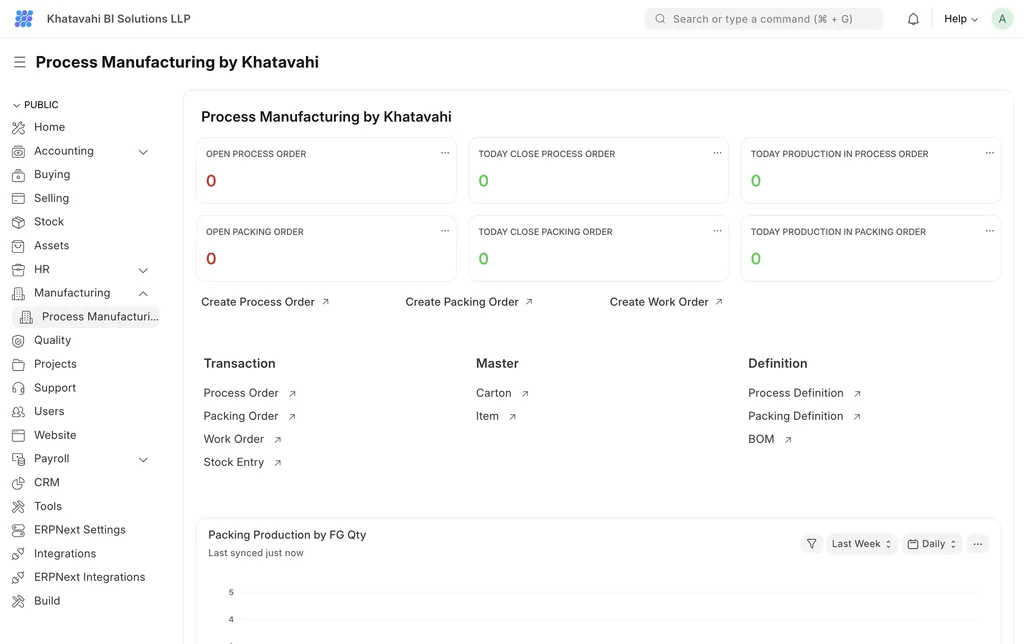
Built on, not bolted on
Where your process needs more, the Frappe Framework underneath ERPNext lets us add it cleanly.
- Custom fields, forms and print formats
- Approval workflows and automated steps
- Shop floor dashboards and new modules
- A built-in REST API for scales, scanners and other software
ERPNext compared with the usual options
How ERPNext stacks up against a licensed ERP and the Tally plus Excel setup many factories start with.
| Point | ERPNext | Typical licensed ERP | Tally plus Excel |
|---|---|---|---|
| Software licence | Free and open source | Paid, usually per user per year | Tally licence, plus spreadsheets |
| Cost of adding a user | No licence cost | Another licence each time | Multi-user needs a higher Tally edition |
| Production, stock, HR and CRM | In the same system as accounts | Often separate add-ons | Mostly in Excel or on paper |
| Source code | Public, you can change it | Closed | Closed |
| Where your data lives | Your cloud or your own server | Often the vendor's cloud | Spread across PCs and files |
| Changing it to fit your process | Custom fields, workflows and modules | Limited, through the vendor | Manual workarounds |
Free software still has to be implemented well. See typical ERPNext costs in India or read what ERPNext really costs.
ERPNext is a strong fit when
- You make products and need production, stock and accounts to agree
- Your team has outgrown Tally plus Excel and keeps re-typing the same data
- You want to add users freely, without paying for every login
- You have a process that off-the-shelf software does not quite match
- You want to own your data and choose where it is hosted
Think twice when
- You only need billing and basic accounts for a small shop
- Nobody in your team can own the system and drive its use internally
- You are not willing to change any part of how the business runs today
We would rather tell you this on the first call than after go-live. If ERPNext is not the right fit, we will say so.
Good software needs a good implementation
ERPNext is not installed, it is implemented. Khatavahi BI Solutions LLP has implemented and customized ERPNext for Indian businesses since 2017, with one team for setup, data migration, training and support.
See our manufacturing ERP and paper plate manufacturing ERP, or read how to choose an ERPNext partner.
Questions about ERPNext
What is ERPNext?
ERPNext is open-source ERP software that runs accounting, stock, manufacturing, buying, selling, CRM, projects and HR in one system. It is developed by Frappe, a company based in Mumbai, and released under the GNU GPL v3 licence.
If ERPNext is free, what do I pay for?
There is no licence or per-user fee. You pay for implementation, any customization, hosting and ongoing support. For Indian manufacturers, one-time implementation typically costs ₹3.5 lakh to ₹10 lakh, depending on size, modules and customization.
Is open-source ERP safe for business data?
Yes, when it is hosted and maintained properly. Because the code is public, it is reviewed by developers worldwide and security fixes are released openly. Good hosting adds daily backups, SSL encryption, firewalls and regular updates, and you can keep the data on your own servers.
Is ERPNext suitable for manufacturing?
Yes. ERPNext includes multi-level BOMs, production planning, work orders, job cards, subcontracting, quality inspection and costing. Industry-specific steps can be added with the Frappe Framework.
Does ERPNext handle Indian GST?
Yes. The open-source India Compliance app adds GST invoicing, e-invoice and e-way bill generation, GST return data and reconciliation, and TDS. Frappe HR adds payroll with PF and ESIC.
How is ERPNext different from Tally?
Tally is a strong accounting and billing tool. ERPNext covers accounting too, but also production planning, job cards, quality, CRM, HR and approvals in the same system, with as many users as you need and no per-user licence. Many manufacturers move from Tally to ERPNext as they grow, and existing Tally data can be migrated.
What happens if Frappe stops developing ERPNext?
Your system keeps running. The full source code is public under the GPL v3 licence, so you, your partner or the wider community can keep maintaining and improving it. No one can switch off software you host and own.
Is ERPNext only for small businesses?
No. ERPNext is used by small businesses as well as multi-company, multi-location groups. How well it performs at scale depends on good hosting and a well-planned implementation.
Find out if ERPNext is right for your business
Tell us how you work today. We will tell you honestly whether ERPNext fits, and what it would cost.
Get a free estimate Call +91 73596 46977